
Supplier name: Cerco C2C Academy CIC Ltd
Publication date: 08/04/2026
Baseline Emissions Footprint
Baseline emissions are a record of the greenhouse gases that have been produced in the past and were produced prior to the introduction of any strategies to reduce emissions. Baseline emissions are the reference point against which emissions reduction can be measured.
| Baseline Year: 2025 | |
| Additional Details relating to the Baseline Emissions calculations. | |
| Baseline year emissions: | |
| EMISSIONS | TOTAL (tCO2e) |
| Scope 1 | Direct Emissions 0 tCO2e |
| Scope 2 | Electricity 8.09 tCO2e |
| Scope 3 | Estimated Scope 3 536tCO2e 280 learners * 110 return journey * 60 travel days = 1,848,000 miles of travel * 0.00029 (standard UK car travel factor) |
| Total Emissions | 544.09 tCO2e |
Current Emissions Reporting
| Baseline Year: 2026 | |
| EMISSIONS | TOTAL (tCO2e) |
| Scope 1 | Direct Emissions 0 tCO2e |
| Scope 2 | 2.20 tCO2e year to date |
| Scope 3 (Included Sources) | 81 * 110 * 14 = 124,740 miles of travel * 0.00029 (standard UK car travel factor) |
| Total Emissions | 36 tC02e YTD |
Emissions reduction targets
In order to continue our progress towards achieving Net Zero, Cerco C2C Academy CIC Ltd has adopted the following carbon reduction targets.
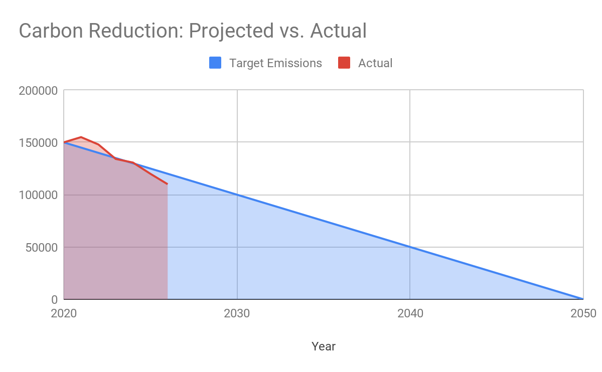
Using 2025 as the baseline year, with total emissions of 544.09 tCO₂e, we project that carbon emissions will decrease over the next five years to approximately 490 tCO₂e by 2030. This represents a circa 10% reduction against the 2025 baseline.
This reduction will be driven primarily by a continued decrease in learner travel emissions per programme, through expanded blended delivery, reduced on‑site attendance days, and improved cohort scheduling, alongside sustained low‑carbon office operations.
Progress against these targets can be seen in the graph below:
Carbon Reduction Projects
Completed Carbon Reduction Initiatives
The following environmental management measures and projects have been completed or implemented since the 2025 baseline year.
The carbon emission reduction achieved by these schemes is estimated at approximately 54 tCO₂e, representing a circa 10% reduction against the 2025 baseline. These measures will remain in effect when performing the contract.
Cerco Academy recognises that the majority of its carbon emissions arise from learner travel to its Crewe delivery location, categorised as Scope 3 emissions. While learner travel is not directly controlled by the organisation, Cerco Academy seeks to minimise and manage its impact through proportionate and practical measures
Completed Carbon Reduction Measures
Cerco Academy has implemented the following actions to reduce carbon emissions:
Blended and remote delivery models, reducing the need for regular learner and staff travel.
Condensed and cohort‑based timetabling, minimising the number of required learner travel days.
Energy‑efficient office operations, including low‑energy IT equipment, power‑down policies, and monitored electricity usage benchmarked against UK office norms.
Digital‑first delivery and administration, reducing paper use and associated emissions.
Reduced business travel, with meetings and stakeholder engagement conducted virtually wherever possible.
Future Carbon Reduction Measures
Where emissions cannot yet be avoided, Cerco Academy intends to consider verified UK‑based carbon offset schemes, alongside further reduction activities.
In the future we hope to implement further measures such as:
Expanding remote and regionally accessible delivery models to reduce long‑distance learner travel
Further reductions in learner travel days per programme
Continued refinement of carbon data accuracy for Scope 3 emissions
Formalising proportionate environmental management practices aligned to recognised standards
Exploring renewable electricity options or green tariffs where commercially feasible
Cerco Academy is committed to continuous improvement through transparent and proportionate environmental management.